Vinyl siding · Tulsa, OK
Vinyl Siding Repair in Tulsa, OK
Vinyl is the most common siding on Tulsa homes built since the 1980s, and it is also the siding that takes the most damage here: hail cracks it, wind unlocks it, summer sun warps it and window reflections can melt it. The good news is that vinyl is the easiest siding to repair one panel at a time. We replace cracked, holed, loose, warped and melted vinyl siding panels across Tulsa and match the existing profile and color so the repair blends in.
Call (918) 600-9391 for a free vinyl siding repair estimate. Send a close-up of the damage and a photo of the whole wall to speed things up.
- Free estimates
- Profile and color matching
- One-panel repairs from $175
- Most repairs in under half a day

Quick answer: A single vinyl siding panel in Tulsa costs about $175 to $350 to replace with matching stock. Two to five panels on one wall usually run $300 to $750, and a 100 square foot section runs $500 to $1,000. Most vinyl repairs are finished in under half a day.
Vinyl Siding Problems We Repair
Vinyl fails in a handful of predictable ways. Naming the problem correctly matters, because two panels that look the same from the driveway can need very different fixes.
Cracks, holes and broken panels
- Hail cracks and punctures: round holes, star cracks and broken bottom locks, usually on the west and north walls.
- Impact damage: lawn mower and string trimmer strikes near the ground, basketballs, ladders, grill lids.
- Cold cracks: vinyl loses impact strength as it gets cold, so a panel that dented in July can crack from the same hit in January.
- Nail cracks: a crack running from a nail slot usually means the nail was driven tight. The panel could not move, and it split.
Cracked panels should be replaced, not caulked. Caulk is a temporary patch at best, and a crack lets water run behind the panel onto the house wrap.
Loose, buckled and warped siding
- Panels unlocked by wind: a gust gets under a loose course and pops it off the lock of the panel below. You will see a panel hanging or gaping at the bottom.
- Buckling and waves (oil canning): panels nailed too tight, or butted too tight into J-channel, have nowhere to go when they expand in summer, so they bow outward.
- Panels blown off completely: common on gable ends and second story walls with long, unbroken runs.
Buckling is often an installation problem, not a damaged panel. We re-hang the affected courses with the right nail spacing and gap instead of just swapping the visible panel. Our guide to why vinyl siding warps and buckles explains the cause in detail.
Melted vinyl from windows and grills
Vinyl siding starts to distort at about 160 to 165 degrees Fahrenheit. Energy efficient low-E windows on a neighbor's house, a storm door or a sliding patio door can reflect and concentrate summer sun onto a wall and push panels past that point. The tell is a wavy, sagging patch in a curved shape that appears only in summer. Grills parked too close to the wall cause the same thing from the other direction.
Replacing melted panels without fixing the cause means melting them again. We help you find the reflection source and recommend a fix, such as a screen on the reflecting window, a shrub or trellis, or a heat-resistant vinyl or composite panel in that zone.
How We Repair Vinyl Siding
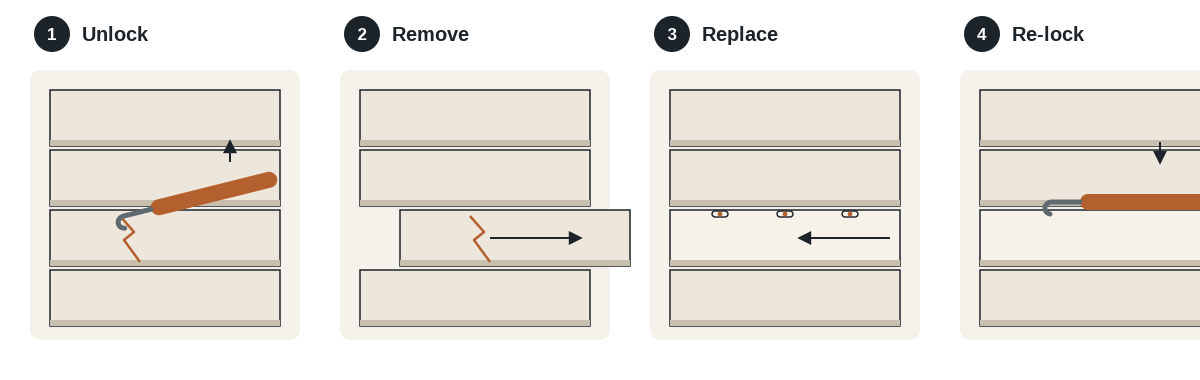
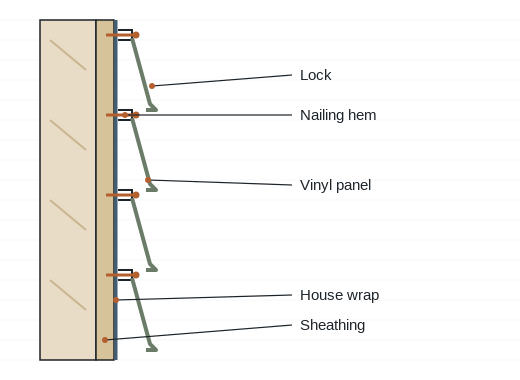
Vinyl siding is designed to be taken apart. Each panel locks into the one below it and hangs from nails in long slots along its top hem. That is what makes one-panel repairs possible.
Step by step panel replacement
Unlock the panel above. A siding zip tool hooks the bottom lock of the course above the damage and pulls it free along its length.
Pull the damaged panel's nails. With the upper panel lifted, the nails holding the damaged panel are exposed and removed.
Inspect the wall. We check the house wrap or foam backer for tears and the sheathing for soft spots. Hail rarely reaches the sheathing, but long-term leaks at windows and corners often do.
Fit the new panel. The replacement is cut to length with an end gap of about 1/4 inch at each J-channel or corner post, slightly more in cold weather.
Nail it loose. Nails go in the center of the slots, about 16 inches apart, and are left about 1/32 inch proud (roughly the thickness of a dime) so the panel can slide.
Re-lock both courses. The new panel snaps into the course below, and the zip tool locks the upper panel back down.
Why expansion gaps matter in Oklahoma
Vinyl moves a lot with temperature. A standard 12 foot panel can grow and shrink by about 1/2 inch between a cold January morning and a 100 degree July afternoon on a west wall. Tulsa sees that range every year. If the panel cannot move, it buckles in summer or cracks at the nail in winter. Most of the "my siding keeps coming loose" calls we get are really expansion problems left by the original installer.

Matching Your Existing Vinyl Siding
Matching is the real skill in vinyl repair, and it is where most cheap repairs go wrong. A panel can be the right color name and still look like a patch.
Profile and brand
We identify your siding by measuring its exposure (the visible height of each course), the number of laps per panel, the butt height and the woodgrain pattern. Common profiles on Tulsa homes include double 4 inch and double 5 inch clapboard, Dutch lap, beaded, and vertical board and batten on gables. Common brands in the area include CertainTeed, Royal, Mastic, Alside, Variform and Georgia-Pacific (older homes). Some older colors and profiles are discontinued, which is where salvage comes in.
Faded color and salvage swaps
Even when the original panel is still made, the panel on your wall has faded for years under Oklahoma sun. Options, from best to acceptable:
- Salvage swap: take matching panels from a low-visibility area (behind a fence, inside a screened porch, a back garage wall) for the visible repair, then install new panels in that hidden area.
- Full-wall replacement on the damaged side: if one elevation is badly damaged, replacing the whole wall to a corner or break gives a clean line instead of a patchwork.
- Closest available match: used where the repair is on a rear or side wall and you prefer to keep cost down. We show you the sample against your wall before ordering.
More detail is in our guide to matching old vinyl siding.
When Vinyl Siding Should Be Replaced Instead
Repair stops making sense when the vinyl itself is failing, not just damaged. Signs we look for:
- Panels are chalky, brittle and crack when unlocked, which is common on 25 to 30 year old builder-grade vinyl.
- Damage covers several walls after a large hail event and insurance has approved replacement.
- The sheathing behind the siding is soft in several places, so the wall has to be opened anyway.
- No salvage source exists and the profile is out of production.
In those cases we will tell you and price the alternatives. See siding replacement in Tulsa for how we approach it.
Vinyl Siding Repair Cost in Tulsa
| Vinyl repair | Typical Tulsa price |
|---|---|
| Re-hang loose or unlocked panels (no new material) | $150 to $300 |
| Replace 1 panel with matching stock | $175 to $350 |
| Replace 2 to 5 panels on one wall | $300 to $750 |
| Replace a 100 sq ft section | $500 to $1,000 |
| Replace a full single-story wall (about 400 sq ft) | $1,800 to $3,600 |
| Replace damaged J-channel or corner post | $125 to $300 each |
| Replace melted panels and add a heat-resistant zone | $350 to $900 |
| Second story or gable access | Add $100 to $300 |
Insulated vinyl and premium thick panels (0.046 inch and up) cost more per panel than standard 0.040 to 0.042 inch builder grade. See all repair prices on our siding repair cost page.
Vinyl Siding Repair Around Tulsa
We repair vinyl siding in every Tulsa neighborhood, with the most calls from the south Tulsa subdivisions built from the 1980s through the 2000s where vinyl was the default choice. We also cover the suburbs where vinyl is common on newer homes:
If the damage came from a storm, our hail damage siding repair page covers documentation for insurance. If your fascia or soffit took damage too, see soffit and fascia repair. For other materials, see James Hardie siding repair.


Free estimate
Get a Vinyl Siding Repair Estimate
Call (918) 600-9391 or email info@tulsasidingrepair.com with a photo of the damaged panel, a wide shot of the wall, and if you can, a photo of the back of a spare panel if you have one in the garage (the brand and color are often printed there). You can also use the estimate request form. This page is part of our full range of siding repair in Tulsa services.
- Call(918) 600-9391
- Email photosinfo@tulsasidingrepair.com
- HoursMon to Fri, 7:30 AM to 6:00 PM
Request received
Thanks. We have your request and will contact you within one business day. If panels are missing and rain is coming, call (918) 600-9391 so we can prioritize a temporary cover.
Questions
Vinyl Siding Repair FAQs
Can you replace just one piece of vinyl siding?
Yes. A single vinyl panel can be replaced without touching the rest of the wall. The panel above is unlocked with a zip tool, the damaged panel's nails are removed, and a new panel is locked into place and nailed loosely. The challenge is matching the profile and faded color. Our guide on replacing one piece of siding covers it.
How much does it cost to replace one panel of vinyl siding in Tulsa?
About $175 to $350 for one panel with matching stock on a single-story wall. Most of the cost is the service call and matching, so each extra panel on the same wall adds far less, roughly $40 to $90. Second story access or a hard-to-find profile can add $100 to $300.
Can cracked vinyl siding be fixed without replacing the panel?
Small cracks can be sealed with color-matched exterior caulk or a vinyl patch as a temporary fix, but the panel should be replaced. Cracks grow as the panel expands and contracts, especially in cold weather, and they let rain run behind the siding. A patch is fine to get through a few weeks until the replacement arrives.
Why does my vinyl siding keep coming loose?
Repeated loose panels usually mean the original nailing was wrong: nails too far apart, nails missing the slot center, or nails driven so tight the panel cannot slide. Wind then lifts the course off its lock. The fix is to re-hang the affected courses with correct nail spacing, not just snap them back on.
What causes vinyl siding to melt?
Vinyl starts to warp at around 160 to 165 degrees. Sunlight reflected by low-E windows, glass storm doors or a neighbor's windows can concentrate enough heat on one spot to reach that temperature. Grills placed near the wall do the same. Fix the reflection or heat source before replacing the panels, or the new panels will melt too.
Will new vinyl siding panels match my old siding?
They can if we find the same profile and the color has not faded much. On siding older than about 10 years, new panels usually look slightly darker or brighter. A salvage swap, moving original panels from a hidden wall to the repair area, gives the closest match. We show you options before ordering.
Can vinyl siding be repaired in winter?
Yes, with care. Below about 40 degrees, vinyl is stiff and cracks more easily when unlocked, so crews work slowly and leave a slightly larger end gap. Emergency repairs, like a panel blown off before rain, should not wait for warm weather because exposed house wrap is not meant to be the final water barrier.
How long does vinyl siding last in Tulsa?
Vinyl siding typically lasts 20 to 40 years in Oklahoma, depending on panel thickness, color and sun exposure. Thin builder-grade vinyl on south and west walls fades and becomes brittle sooner. Hail can shorten that by cracking panels, but individual repairs extend the life of the rest of the wall. Read how long siding lasts in Oklahoma.