
Short answer: One piece of vinyl siding is replaced by unlocking the panel above with a zip tool, pulling the nails, and sliding in a new panel. Fiber cement and wood boards are released by cutting hidden nails, then the new board is face nailed, sealed and painted. In Tulsa, one piece typically costs $175 to $350 for vinyl and $250 to $450 for fiber cement or wood with paint.
How One-Piece Replacement Works by Material
Vinyl siding
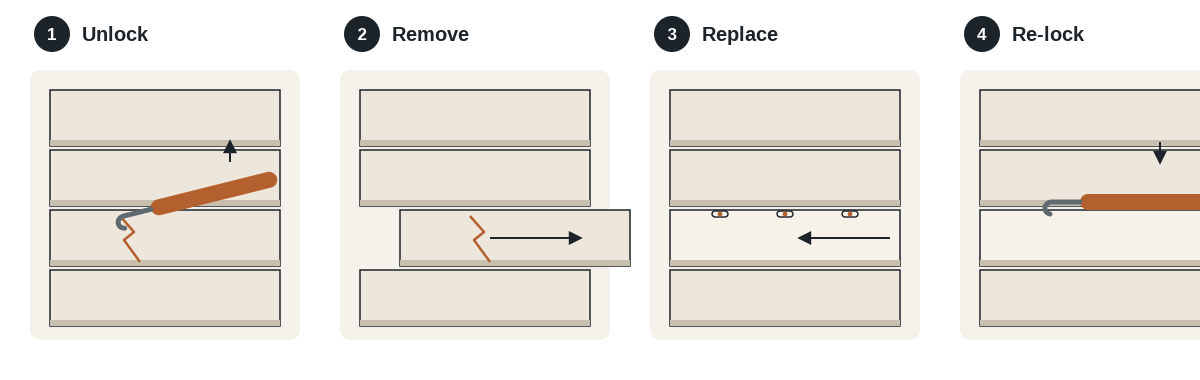
Hook a siding zip tool under the bottom edge of the panel above the damaged one and slide it along to unlock it.
Lift the upper panel to expose the nails along the top of the damaged panel and pull them.
Unlock the damaged panel from the one below and remove it.
Cut the new panel to length, leaving about 1/4 inch at each end for expansion.
Lock the new panel into the course below, nail through the center of the slots without driving nails tight, then lock the upper panel back down with the zip tool.
Fiber cement, wood and LP
Gently lift or wedge the board above to reach the hidden nails along the top of the damaged board.
Cut those nails with a hacksaw blade or oscillating tool so the board above is not cracked.
Remove the damaged board, often by breaking it out in pieces.
Check the house wrap and sheathing behind it.
Slide in the new board, face nail it near the top just below the board above, fill nail holes, caulk butt joints, prime cut edges and paint.
The Real Challenge: Matching
Matching has three parts, and missing any one shows.
| Match factor | What it means | How we check it |
|---|---|---|
| Profile | Shape: double 4, double 5, Dutch lap, beaded, board and batten | Measure exposure, butt height and laps per panel |
| Color | Faded color after years of sun | Compare samples against the wall in daylight |
| Texture and brand | Woodgrain depth, gloss, panel thickness | Examine the back of the panel for brand marks |
New panels in the "same" color often look darker or brighter than panels that have been on the house for 10 years or more. That difference is usually most visible on south and west walls.
Three Ways to Get a Good Match
- Leftover panels. Check your garage, attic or shed. Builders often left extra siding behind, and it has aged indoors, so it is close to the original color.
- Salvage swap. Take a matching panel from a hidden area (behind a fence, under a deck, inside a screened porch) and use it on the visible repair. Put the new panel in the hidden spot.
- Replace to a break. If no match works, replace the whole wall to a corner, window or trim line so the color change looks intentional rather than patched.
For a deeper look at vinyl, read how to match old vinyl siding.
When One Piece Is Not Enough
Replacing one piece makes sense when the damage is truly isolated. It does not when:
- The panels around it are also cracked, brittle or loose.
- Rot behind the damaged piece has spread to the sheathing.
- The damage is from a wall-wide installation problem, like nails driven too tight.
- No match exists and the wall is highly visible.
What It Costs to Replace One Piece of Siding in Tulsa
| Material | One piece | Each additional piece, same wall |
|---|---|---|
| Vinyl | $175 to $350 | $40 to $90 |
| Fiber cement, with paint | $250 to $450 | $75 to $150 |
| Wood, hardboard or LP, with paint | $200 to $400 | $60 to $130 |
| Aluminum (salvage match) | $250 to $450 | $75 to $150 |
Most of the cost of one piece is the minimum visit. See cost to replace one siding panel and our full siding repair cost page.
Need One Piece Replaced?
Call (918) 600-9391 and send a photo of the damage plus a wide shot of the wall. Learn more about our vinyl siding repair and James Hardie siding repair services in Tulsa.
One-Piece Siding Replacement FAQs
Can I replace one piece of vinyl siding myself?
Many handy homeowners can, with a zip tool, a matching panel, tin snips and a hammer. The common mistakes are nailing the new panel too tight, not leaving end gaps, and cracking the panel above in cold weather. Second story work and fiber cement are better left to a pro.
Where do I find matching siding for one panel?
Start with leftover panels in your garage or attic. Then check the back of an existing panel for the brand and color name and ask a local siding supplier. If the color is discontinued or faded, a salvage swap from a hidden wall usually gives the best match.
Can you replace one piece of Hardie board?
Yes. The board above is gently lifted, the hidden nails on the damaged board are cut, and a new board is installed and face nailed, then caulked, primed and painted. Because fiber cement dust contains silica, cutting should be done outdoors with shears or dust-collecting tools.
Does replacing one piece of siding look obvious?
It can if the color or profile is off. A careful match, a salvage swap from a hidden area, or painting the repaired area (on fiber cement and wood) makes the repair hard to spot. Vinyl on older homes is the hardest to match without a salvage panel.


