
Short answer: Fascia rots mainly from overflowing gutters and missing drip edge. Soffit sags when wet plywood delaminates or its support channel fails. Animals enter through rotted corners and loose panels. Blocked or missing soffit vents trap attic heat and moisture. Each is fixed by repairing the wood and correcting the water or access problem.
The 7 Most Common Problems
| Problem | What you see | Main cause | Typical fix |
|---|---|---|---|
| Fascia rot behind gutter | Peeling paint, soft wood, gutter pulling away | Gutter overflow, no drip edge | Replace fascia, add drip edge, rehang gutter |
| Rot at roof valley corners | Soft corner, staining | Concentrated runoff from a valley | Replace corner, add diverter or flashing |
| Peeling fascia paint | Flaking paint on south and west sides | Sun and heat, old paint | Scrape, prime, paint, or wrap if sound |
| Sagging soffit | Drooping or fallen panels | Wet plywood, failed channel | Replace soffit and support channel |
| Animal entry | Holes, chewed corners, nesting | Rotted or loose material | Remove animals, repair, add metal flashing |
| Blocked or missing vents | Hot attic, condensation | Painted over, insulation blocking, solid soffit | Clean or add vented soffit, baffles |
| Storm damage | Dented wrap, torn trim, missing panels | Hail, wind, limbs | Replace damaged sections |
Why Water Is Behind Most Problems
Gutters
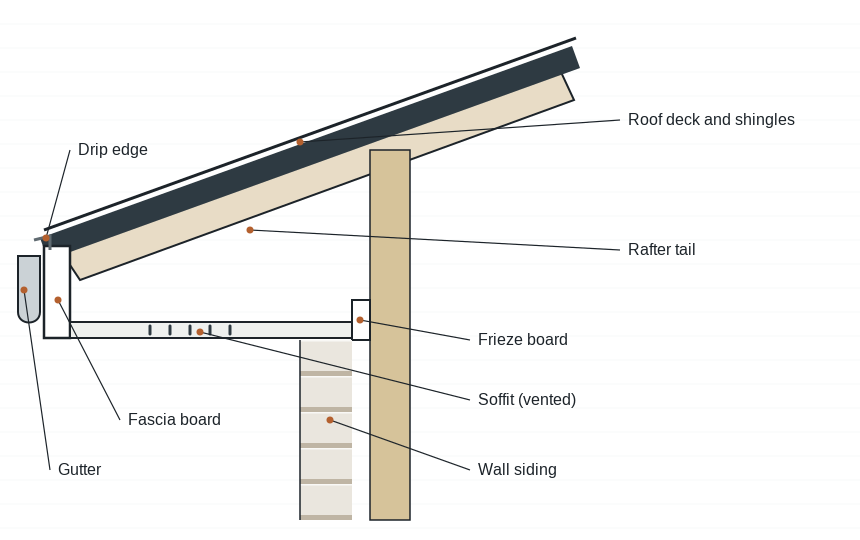
Tulsa's oak, sweetgum and pine trees fill gutters fast, especially in fall. A clogged gutter overflows inward, behind the gutter, soaking the fascia from the back where you cannot see it. Gutters also sag over time, so water pools at low spots and spills over.
Drip edge and roof runoff
Drip edge is the metal strip at the roof edge that directs water into the gutter. When it is missing or too short, water runs off the shingles and down the face of the fascia or behind the gutter. Roof valleys concentrate runoff at one corner and are a frequent rot spot.
Signs Your Soffit or Fascia Needs Attention
- Paint peeling in the same spots every year.
- Gutters pulling away, or spikes and hangers backing out.
- A wavy roof edge or visible gaps between the fascia and the roof.
- Soffit panels sagging, cracked or missing.
- Stains on the soffit or on the siding below the eave.
- Birds, wasps or squirrels going in and out at the roof edge.
- Wrapped fascia bulging or loose, which can hide rot underneath.
Soffit Ventilation in Tulsa Summers
Soffit vents are the intake half of an attic ventilation system. Cool air enters low at the soffit, warms in the attic and leaves high through ridge or roof vents. When soffit vents are blocked, the attic runs hotter, which works the air conditioner harder in Tulsa's July and August heat and can shorten shingle life. In winter, poor airflow lets warm, moist house air condense on the underside of the roof deck.
Common ventilation mistakes
- Solid soffit installed over the old vented soffit during a re-side.
- Vent strips painted shut on wood soffit.
- Attic insulation pushed into the eaves, blocking air from the soffit vents.
- Roof vents added without enough soffit intake to feed them.
How it is fixed
- Replace solid panels with vented soffit where there is attic space above.
- Install rafter baffles (vent chutes) so insulation cannot block the airflow path.
- Clear or replace painted-over vent strips.
- Balance intake and exhaust. A common rule of thumb is roughly equal net free vent area low and high.
How to Prevent Soffit and Fascia Damage
Clean gutters at least twice a year, spring and fall.
Make sure drip edge extends into the gutter.
Keep fascia painted, or wrap sound fascia in aluminum.
Trim branches back from the roof.
Keep soffit vents clear of paint and insulation.
Fix small holes before animals enlarge them.
Get Your Soffit and Fascia Repaired
Call (918) 600-9391 for a free estimate on soffit and fascia repair in Tulsa. Typical cost: $8 to $20 per linear foot for fascia and $350 to $1,200 for a typical one-area job. Related: how to spot siding rot early.
Soffit and Fascia Problem FAQs
What causes fascia boards to rot?
Water. The most common sources are overflowing or leaking gutters, missing drip edge, concentrated runoff from roof valleys and peeling paint that exposes bare wood. Fixing the water source is as important as replacing the board.
Can rotted fascia cause roof problems?
Yes. Fascia supports the gutter and the edge of the roof. If it rots, gutters can pull away and the edge of the roof decking and rafter tails can rot too, which makes the repair bigger. Catching it early keeps the repair to the fascia alone.
Why is my soffit sagging?
Soffit sags when wet plywood delaminates, when the support channels or nailing fail, or when animals push panels loose. Water from a leaking gutter or roof edge is the usual root cause.
Should I wrap my fascia in aluminum?
Wrapping sound fascia in aluminum is a good way to reduce painting. Wrapping rotted fascia only hides the problem while it gets worse. Replace any rotted wood before wrapping.


