
Short answer: Hardboard siding fails when water gets past its paint, causing swollen bottom edges, blistering, soft spots and rot. Damaged boards can be replaced with LP SmartSide or new hardboard-look boards and painted to blend. When soft boards appear on three or more walls, full replacement usually costs less over time.
How to Tell If You Have Hardboard Siding
Visual signs
- Smooth, dense boards with an embossed, very regular woodgrain pattern.
- Lap boards about 7/16 inch thick, thinner than most real wood lap.
- Boards usually 16 feet long, with butt joints covered by metal joint covers or caulk.
- A bottom edge that shows a uniform brown fiber core, not wood grain (real wood) or visible flakes (OSB).
Other clues
- A house built roughly between 1975 and 1998.
- Stamps on the back of boards (visible if one is removed or from the attic at a gable).
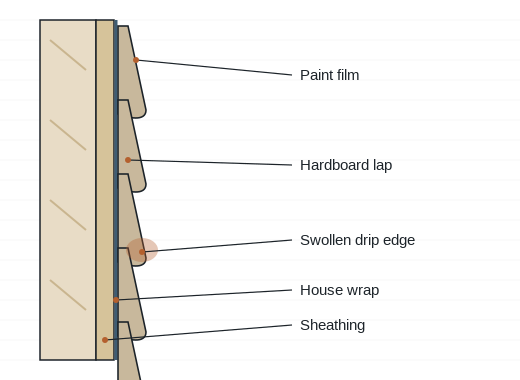
- Swelling or "flaring" at the bottom edges of boards, a classic hardboard failure.
- Original builder paperwork or the county assessor's description of the exterior.
Why Hardboard Siding Fails
Hardboard is basically compressed wood fiber. Kept dry and painted, it can last decades. But when water reaches the core through cracked paint, nail holes, unsealed cuts or bottom edges near the ground, the fibers absorb it and swell. The swelling cracks more paint, which lets in more water. Over a few seasons, boards turn soft, sprout fungus and crumble.
Common entry points:
- Bottom edges within a few inches of soil, mulch, concrete or a roof.
- Nails overdriven through the surface, which break the seal.
- Butt joints without flashing behind them.
- Areas under windows and below roof valleys without kickout flashing.
- Walls hit by lawn sprinklers.
- Paint that has gone too long without recoating, especially on south and west walls.
The Hardboard Lawsuits
In the 1990s, homeowners across the country sued hardboard siding manufacturers, saying the product failed prematurely. Masonite Corporation settled a national class action in the late 1990s, and other hardboard makers faced similar suits. Separately, Louisiana-Pacific settled a major class action in the mid-1990s over its OSB-based siding. Those settlements are closed, so they do not pay for repairs today, but they explain why so many homes from that era have the same problems.
Repair or Replace Hardboard Siding?
| Condition | Best move |
|---|---|
| A few swollen boards at bottom courses, rest firm | Replace those boards, fix clearance, repaint |
| Soft boards on one or two walls | Replace affected boards or sections |
| Soft boards on three or more walls | Price full replacement |
| Paint failing within 2 to 3 years of painting | Replacement likely more cost-effective |
| Sheathing soft behind multiple boards | Replace siding and sheathing on affected walls |
Best replacement boards:
- LP SmartSide: treated engineered wood with lap profiles and textures close to hardboard; good for spot repairs and full replacement.
- James Hardie fiber cement: the most rot and termite resistant; heavier and costs more.
- New hardboard-look products: limited availability; we use them when they match best.
What Hardboard Repair Costs in Tulsa
Replacing one to three hardboard boards with LP SmartSide, primed and painted, typically costs $300 to $750. A 100 square foot section costs about $900 to $1,800. Replacing rotted sheathing adds about $70 to $150 per sheet. Full replacement of a single-story home with LP SmartSide usually costs $14,000 to $24,000. See siding repair cost in Tulsa.
Get Your Hardboard Siding Checked
Call (918) 600-9391 for a free inspection. We probe every bottom course so you get a complete price. Learn more about wood siding repair in Tulsa. Related guide: how to spot siding rot early.
Hardboard Siding FAQs
Is Masonite siding bad?
Hardboard siding is not bad when it stays painted and dry, and many homes still have it in good shape. Its problem is that once water gets in, it swells and rots faster than real wood or modern engineered siding. It needs regular paint and good clearance from the ground.
Can you still buy Masonite siding?
Masonite stopped making hardboard siding years ago. Some hardboard-look products remain, but LP SmartSide is the most common replacement for repairs because its profiles and textures blend well with hardboard once painted.
Can I still file a Masonite siding claim?
The national Masonite and Louisiana-Pacific class action settlements from the 1990s are closed to new claims. Today, hardboard repairs are generally paid by the homeowner, unless damage results from a covered event like hail.
How long does hardboard siding last?
Well-maintained hardboard can last 30 years or more. Poorly maintained or badly installed hardboard can fail in 10 to 15 years. Many Tulsa-area homes from the 1980s and 1990s are now reaching the age where failures are common.


